Advanced game Design: Prototype 5

Prototypes

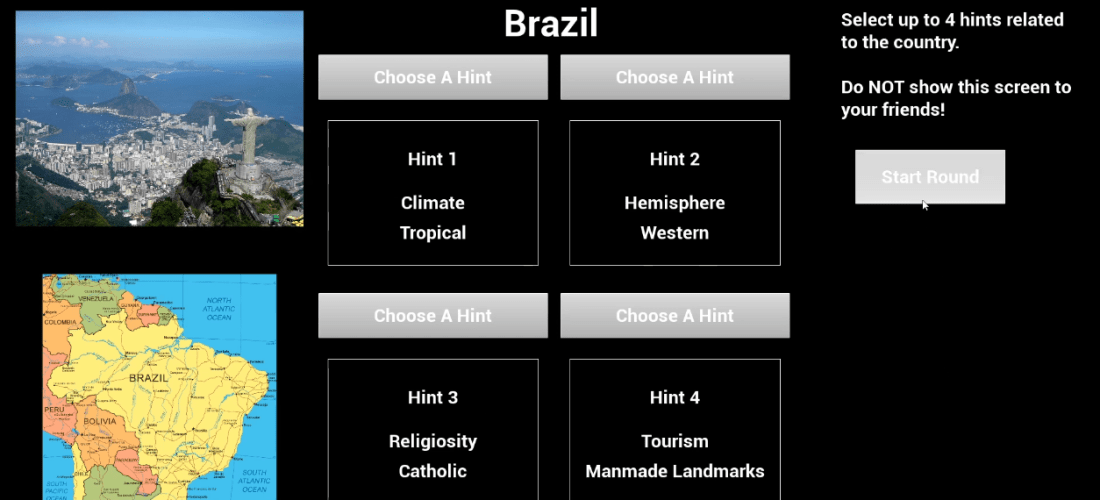
For my second team project and final prototype for my advanced game design class, we were tasked with creating an educational game. Though I am not a huge fan of designing these types of games, I did grow up with them and sunk many many hours into them, so it was oddly fitting to make one as my last project for undergrad. the objective of the game is to give people enough context clues to correctly guess the country in question. My teammate did the Unreal implementation while I painstakingly researched each country, ten in total.

This was created with the intention to be used in a classroom, likely over zoom as this was made while COVID-19 was still running rampant. I will admit it’s not the most thrilling game in the world, but the base is there for a decent geography game should it be developed further. The four hint system is also good because it helps not only the person guessing the country to learn, but also checks the hint giver’s knowledge as well! So it can become a team game similar to gestures or charades.
Advanced Game Design: Prototype 4

Prototypes

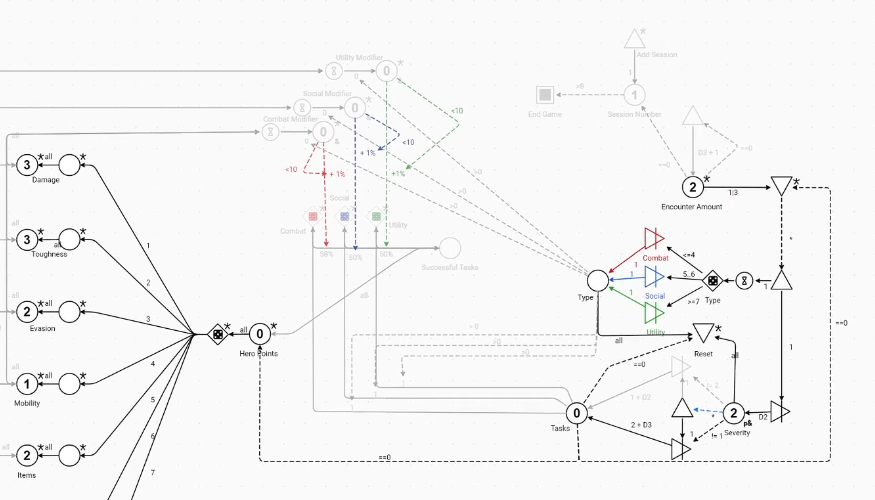
This was a team project between two people where we created an in game economy. My teammate was a huge tabletop board games fan while I have never touched them save for the occasional game of Monopoly or Stratego. While I was at USC I definitely got more of an affinity for them, but when this project was made two years ago, I had no idea what I was doing. My teammate handled the abstract representation, game rules, excel spreadsheet, and tabletop simulator implementation while I handled the Machinations side of things. Even though it may seem like he did more than I did by that list, in reality Machinations took a very long time because we had a complex system and it was a new program.

While at USC, I took a systems class, so now I understand what my teammate was doing as well as what I was doing better in Machinations. Playing D&D helped me realize all of the complex systems and numbers that go into tabletop games. Making and balancing games have made me realize that excel spreadsheets are necessary for a great game experience. My part is at 8:50, but if you have enough time, you can watch the whole thing to get a better understanding of what the Machinations show in regards to the game economy.

Machinations Link: https://my.machinations.io/d/Superpower-RPG/0836ef039bb109c5dccc49fb5384a5f5a

Advanced Game Design: Prototype 3

Prototypes

This project was created for my advanced game design class, a class I took my senior year in 2021 where we learned about game mechanics and prototype examples of those mechanics. For this project, we were expected to cover tactical maneuvering. My mind immediately went to a turn based RPG fighting game, however I have little to no knowledge or experience in the subject. Regardless, I tried my best to make a grid based movement system with limited amounts of turns the player can take.

In a turn, the player can either move or attack. There are 3 possible moves in a single turn, and each player type takes a certain amount of moves to do anything. Green takes one move to do an action, white takes two moves, and blue takes 3 moves. Their health also corresponds with the amount of moves, with green having the least (taking 2 hits of damage) while the blue has the most (8 hits of damage). I didn’t have enough time to program the enemy’s movement, but I was still able to program them lashing out and attacking the player.

Advanced Game Design: Prototype 2

Prototypes

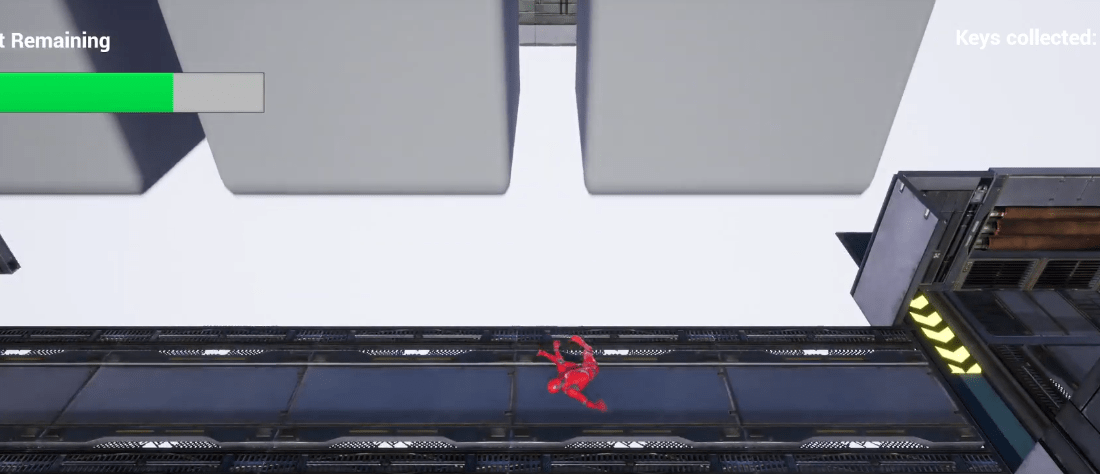
For this project, we were asked to create 3 mechanics indicating progression. This refers to something that prevents the user from moving forward in the level and an item that then helps them progress. In this case, there are turrets that kill the player if they are not wearing a shield, crushers that can be stopped by using up heat, and a door that opens after collecting a certain amount of keys. I made this in Unreal Engine 4 using visual scripting.